
When it comes to sound design within music production, it is important for musicians to remember the ultimate golden rule: There are no rules. That is what makes electronic music production so enticing and versatile. There are however, personally developed guidelines that differ from producer to producer. Here are a few tactics that can easily be overlooked, but have the potential to increase the sound quality of your productions tremendously. Like every aspect of music production, the more you know, the more fun you can ultimately have!
The circle of 5ths. I know I probably scared some of you off right? Don’t fret! I am here to shed some light on this for you. In actuality, it is a really simple concept to grasp when you strip away the theory, and focus on the sound. Lets call it the circle of filth. When this principle is combined with bass sound design, you have the ability to control the sound, and be more creatively free because your ideas will make sense musically. Your sounds will take a shape that is coherent with the idea of the track. You can further add aspects and layers to your music that would have otherwise trampled the concept of your song.
To explain briefly the circle of 5ths, it is a diagram which has the musical keys mapped out. It looks something like this:
Circle Of Fifths For Bass Sound Design

The circle of 5ths is an initial guideline of what notes will work together, and which ones won’t. It comes from the keys on a piano, or in our case, an extremely awesome analog Korg synthesizer 🙂 Basically, by counting the notes on a keyboard, we can use our circle diagram to find the notes that will
sound good together. Simple right? The amount of notes we count to get to the next compatible note is measured in steps and semitones, where one step on our synth is like moving from the note C to D like this:
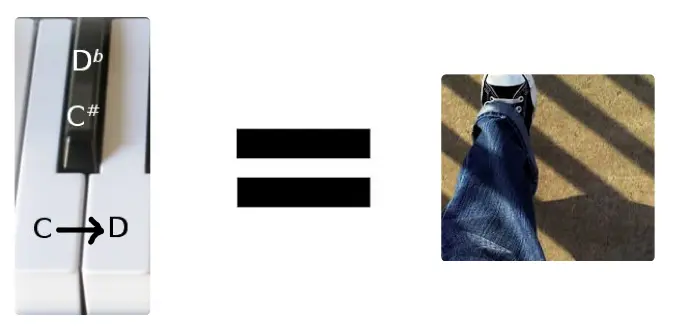
If we were to only move to the C# note, then we have only moved a half step, or semi- tone. The circle of 5ths tells us how many tones we need to move on our keyboard to find the next most comparable sound to the one we are playing. Referring back to our wheel, the counting of our steps (tones) has already been done 🙂 If we start at C and move to the right on the wheel we see the next letter is G. On our keyboard, we can literally start on C and count up 5, skipping the black keys, to get to G. The C is number one, D is number two, and so on. This distance is called a 5th. This note will always sound good, no matter what note you start on. There are other rules which are beyond our goals here, but that should give you a good start. Lets turn that into the circle of filth!
So, how does it work? I am glad you asked. Lets take an instance of operator:
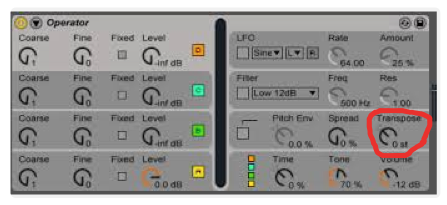
Operator is an FM Synth, where the FM is frequency Modulation. Literally, modulating frequencies. Crazy right? Don’t let the big name scare you. We can utilize the circle of
5ths to make our operator sounds have layers that sound good 🙂 Starting at C, we know that the note G is a compatible note, and will provide a suitable layer! We can then adjust our Tranpose tuning to match the amount of semitones that equal one 5th. Again, we literally count how many semitones are from G to C and get 7. Therefore, we know that 7 will be harmonically correct. We can then group our operator instances into layers that are harmonically compatible using instrument racks, like so:
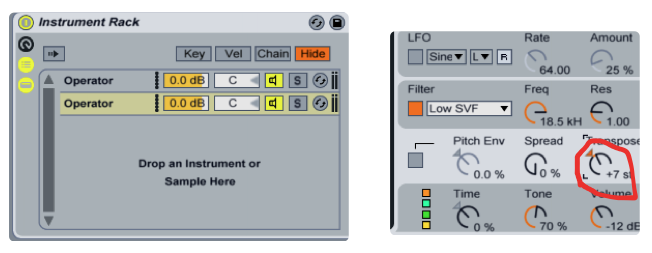
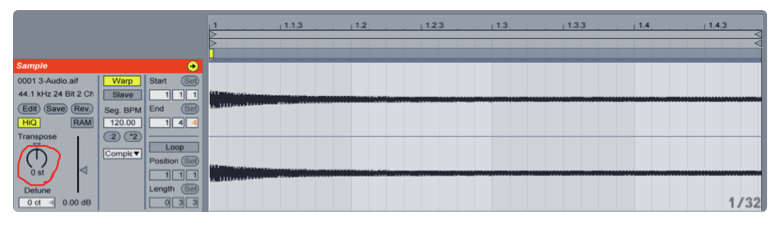
Applying this theory will allow you to try all sorts of new and exciting combinations that will be harmonically correct. The same theory also applies when we are working within the audio realm, after bouncing tracks. The transpose feature is located within the clip itself, shown here:
I hope this has been informative for you, and feel free to ask me any questions if something is unclear 🙂 I will do my best to answer all of them. Until then, I am excited to see how you will utilize the circle of filth!
To show this content you have to accept our cookies.
To show this content you have to accept our cookies.